
In northern Morocco, speaking several languages is no longer a bonus. It shapes university success, jobs in tourism or at Tanger Med, and study or work plans in Europe. Language centres are multiplying in Martil and Tetouan, but quality varies widely. This guide lists the criteria that separate a real language centre from a simple classroom, and explains how Safari Institute applies its learning-by-doing method to English, French and German.
Why learn a language in Martil and Tetouan now
The Tetouan region lives in constant contact with Europe: beach tourism in Martil, M'diq and Fnideq, the Tanger Med industrial zone, and diaspora families returning every summer. French remains the language of science at Moroccan universities, English is the language of tech and international business, and German opens highly sought-after training and job pathways.
For children and adults alike, the real question is not whether to learn a language, but where to learn it efficiently — without years of grammar drills that never turn into real conversation.
Explore all our courses: Safari Institute language hub
What makes a good language centre
Group size comes first: beyond about twelve learners, each person only speaks a few minutes per session. Second, placement by actual level, assessed at the start, rather than by age or school year.
Third, a method that makes people speak. The most effective centres spend most of the time on real situations — introducing yourself, arguing, storytelling, negotiating — and treat grammar as a tool for expression. Finally, a good centre states clearly what the learner will be able to do at the end of each module and provides written progress feedback.
A last point is often overlooked: regularity. Two short, well-prepared sessions per week usually produce better results than one long session, because the brain consolidates a language through frequent exposure. A good centre helps families build a realistic rhythm and keeps learners engaged between classes with small, achievable challenges.
Questions to ask before enrolling
How many learners per group? How is level assessed? How much of each session is speaking practice? What happens if my child progresses faster than the group? Clear answers are the best sign of a serious centre.
Language courses in Martil
Families in Martil want courses close to home that fit the school timetable and, in summer, the stays of diaspora families. Our English, French and German courses in Martil run in small groups, weekly during the school year and in intensive formats during holidays.
Language courses in Tetouan
In Tetouan, demand also covers exam and certification preparation, support for high-school and university students, and courses for adults changing careers. Our Tetouan programmes follow the same active method with a structured, level-based progression.
See details: English courses in Tetouan
Online and diaspora options
Families in M'diq, Fnideq, Tangier or elsewhere in Morocco, and diaspora families between visits, can follow part of our programmes online with the same teachers and method.
All remote formats: online language courses in Morocco
For families abroad: summer camp in Morocco
What a typical session looks like
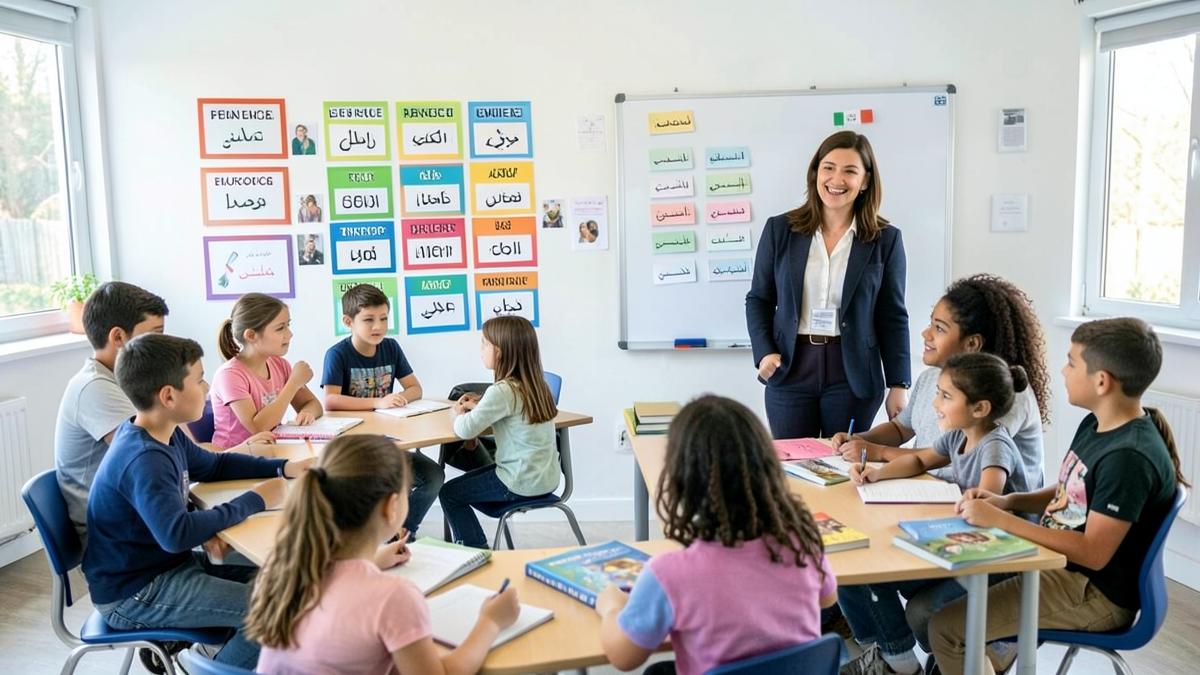
Every session opens with a short speaking warm-up: each learner describes their day, comments on a picture or answers an open question. The goal is to get everyone talking from the first minute, including the shyest learners, before the topic of the day is introduced.
Next comes a real-life scenario: ordering at a restaurant, preparing a job interview, presenting a project or debating a current issue. The grammar point or vocabulary is discovered through that scenario, then reinforced with a short, focused exercise. The teacher moves around the room, corrects orally and notes recurring mistakes for the next session.
The session ends with a concrete output: a dialogue performed in front of the group, a short presentation or a written message. This lets learners measure what they can actually do, and lets parents follow their child's progress week after week.
Conversation and reading clubs
Alongside regular classes, our English and German reading and conversation clubs offer an informal space to practise without the pressure of grades. Learners read, discuss and explore the culture behind the language, which keeps motivation high between modules and noticeably speeds up spoken fluency.
Progress tracking
At the end of each module, a written report shows the level reached, strengths and areas to work on. For families who are only in Morocco part of the year, this report makes it easy to pick up exactly where the learner left off, in class or online.
Placement on day one
New learners take a short oral and written placement activity during their first session. It is not an exam: it simply lets us place each learner in a group where they are challenged without feeling lost, whatever their age or school background.
Which language fits your project
For primary and middle-school pupils, French is often the priority: it is the language of science subjects in Moroccan high schools and universities, and weak written expression becomes costly at the baccalaureate. Working early on reading, writing and speaking avoids having to catch up later under pressure.
English becomes essential as soon as a child is interested in technology, video games, coding or studying abroad. It is also the language of the certifications required by many universities and employers. Starting with speaking, using materials linked to the learner's interests, makes progress feel natural rather than forced.
German mainly concerns teenagers and adults planning vocational training, studies or work in Germany, Austria or Switzerland. The pathway is more demanding, but the opportunities are concrete, particularly in healthcare, engineering and technical trades, where demand for qualified people keeps growing.
Many families in Martil and Tetouan combine two languages: French for school, and English or German for the long-term project. Our timetables are designed to make that combination possible without overloading the week.
Adults are welcome too. Whether the goal is a promotion, a job in tourism, a university application or simply the pleasure of travelling with confidence, we build a pathway around a clear, measurable objective and adapt the pace to professional constraints, with evening, weekend and online options where available.
The Safari Institute approach: learning by doing
At Safari Institute, a language is learned as a practical skill: practise first, understand next, formalise last. Role plays, projects, presentations and conversation clubs replace long conjugation sessions — the same philosophy as our coding and robotics workshops.
To find the right level and format, book a trial session or message us on WhatsApp at +212 664 157 864.
Questions fréquentes
What is the best language centre in Martil?
The best centre combines small groups, placement by real level and a speaking-first method. Safari Institute offers English, French and German courses in Martil on these principles.
Do you offer adult language courses in Tetouan?
Yes, our Tetouan programmes welcome children, teens and adults, grouped by level.
Are the courses available online?
Yes, part of our programmes is available online across Morocco and for diaspora families.
From what age can my child start?
Children can start in primary school with playful, speaking-based formats. We assess each learner's level during the first session and place them in a group where they are challenged without feeling lost, rather than grouping strictly by age.
Do I need to buy books or materials?
No. All teaching materials are provided during the sessions. For learners who want to practise at home, teachers recommend free resources, podcasts and reading suggestions matched to their level.
How do I choose between Martil and Tetouan?
Choose the location closest to home or school so attendance stays regular — regularity matters far more than location. The method, group sizes and progress reports are the same in both cities, and learners can switch to online sessions when travelling.